

Just good old fashioned marigolds but makes a great fall flower for the vase. Have been saving the seed each year and planting again until I forget where they originally came from. Easiest flower for saving seed. #inavaseonmonday
Just good old fashioned marigolds but makes a great fall flower for the vase. Have been saving the seed each year and planting again until I forget where they originally came from. Easiest flower for saving seed. #inavaseonmonday

Labor Day Weekend Haul of Tomatoes
I have always grown tomatoes from seed, simply because I like to grow plants from seed. Tomatoes are particularly easy, they germinate fast and are easy to grow. Each year I start different tomato seeds indoors under lights and end up with many to give away. My family of four loves fresh tomatoes in the summer so I grow at least half a dozen tomato plants in our Virginia backyard.
This spring, a representative from Burpee Home Gardens asked if I would like to grow several tomato plants that Burpee was going to introduce in 2018. I was intrigued. Since I have not bought tomato plants in years, I thought it would be interesting to see the difference between these hybrids and my plants. Burpee has been selling seed for over 140 years but they also sell plants and they offer both heirlooms and hybrids for some of their vegetables.
I had already started the heirloom Marglobe (determinate slicer) from a source other than Burpee (Burpee also sells this) and Chianti Rose (indeterminate beefsteak) from seed when Burpee had contacted me. In May, I planted my seedlings and Burpee’s plants, each with a 6-foot tall post. Deer came through once or twice in early summer so I was left with the following from Burpee: two Gladiators (indeterminate paste), two Oh Happy Day (indeterminate junior beefsteak), and one Tomato Combo Take 2 Blockbuster (a determinate slicer and a cherry together). I also had two Marglobe and four Chianti Rose plants.

Heirloom Chianti Rose tomato
My two heirloom tomatoes are plants that have been grown from seed for generations. Heirlooms are usually passed down and have a story connected with them or are a family favorite. I could save the Marglobe or Chianti Rose seed, plant them next year, and get exactly the same type of plant. The Burpee plants are cultivars that have been bred to have particular characteristics. I could save the seed, plant them next year, and get tomatoes but they would not retain the same desired characteristics that Burpee had selected (usually disease resistance). Except for the annual deer visit, I don’t have a serious disease/pest problem in my garden with my plants.

Heirloom Marglobe, a determinate tomato plant
I do grow a combination of determinate and indeterminate tomato plants to space out my harvest. Indeterminate plants grow, bloom, and fruit over and over again until frost so you can harvest tomatoes throughout the summer. Determinate plants will stop growing when fruit sets on the top buds so the tomatoes ripen at the same time in a window of a few weeks.
As the summer progressed, I watered all the plants often with a hose, fertilized a few times, and strung the branches to the post with yarn (leftover from kids’ projects). This year, however, I felt that I had to keep stringing the tomatoes, more often than in the past. Every weekend I was stringing up the Gladiator and the Oh Happy Day plants to the stake and then having to string the branches up so they would not fall down. These two in particular were growing fast, with many branches and more weight. My yarn was becoming an aerial infrastructure just to keep branches up. My heirlooms were growing well but not as robust or as branched as these Burpee plants.

Burpee’s Gladiator paste tomato plant
In mid-August, I had harvested about 2 red tomatoes from the two Gladiator plants, which had about 10 green tomatoes on each plant. Gladiator is the first paste tomato plant that I have grown and it is firm enough for sandwiches and salads, not as wet and messy as the slicers or beefsteaks. Traditionally, paste tomatoes are used for pasta sauce and for dehydration so I plan to use these in our pasta sauce, chili, and bean stew. I would definitely use a cage next time; one stake is not enough. This particular type was bred to resist blossom end rot, which rarely occurs in my garden, but I did not see it on these plants.

Burpee’s Oh Happy Day with red tomato
The Oh Happy Day gave me a couple of red junior beefsteak tomatoes early in the season, which we used in salads and sandwiches. Anything that colors up early in the season is a plus in my book. In mid-August there were about 20 green tomatoes on each of the plants. This plant was very vigorous and again, I would use cages next time. The fruit clustered together, making it easy to simply twist a ripe one off the vine.
The Tomato Combo Take 2 Blockbuster is a combination of a small cherry tomato, a yellow indigo, and a determinate red slicer. Although I planted these in the ground, I would recommend planting in a large container on the deck. The plants are only a few feet tall and would make a great conversation piece on the deck or patio. It would also make it easier for people to see the pretty yellow indigo tomatoes. By mid-August, I harvested about 10 yellow indigos and a red slicer but there were about 5 green slicers and a few more yellow indigos on the plant.

Yellow Indigo cherry from Burpee’s Tomato Combo Take 2 Blockbuster plant
In mid-August, the Marglobe had a dozen green tomatoes on each plant. The plant seemed to be okay with the stake, it was not as heavily branched or as “viney” but then it is a determinate. Marglobe has very pretty fruit, red and round like a ball.
The Chianti Rose plants had about five green tomatoes on each plant. The Chianti Rose is not a pretty tomato, it is large and flattened, sort of an oblong beefsteak. It ripens to pink instead of red. Because the fruit is large, the plant bends under the weight. A cage would have been better, plus each plant took up a lot of space.
I have to confess I rarely have pests or diseases with my tomatoes so I did not notice any difference between Burpee’s plants and the heirlooms in this regard. I did notice that the Burpee plants had more vigor and growth so it would have been best to use cages for the Gladiator and the Oh Happy Day plants. They were large plants with many branches and more tomatoes than the Marglobe and Chianti Rose. If I had to do it over again, I would have put the Tomato Combo Take 2 Blockbuster in a container. All of the tomatoes tasted good and it was great to learn that the paste tomatoes could be used for sandwiches and salads as well as pasta sauces. I am sure Burpee will have these plants for sale at the local garden centers next year.
Next year, grow tomatoes in the garden or in a container. Nothing beats their fresh taste — summer in a bite!

Oh Happy Day grows in clusters, easy to pick
Tagged Burpee, container plants, heirloom, seeds, tomato, vegetables
 Today I tweeted that it would be good to pull weeds since it had rained buckets for the past few days, thus decreasing the heat and humidity and loosening the soil. For me, the time was ripe to pull an invasive plant from my garden, balloon flower (Platycodon grandiflorus). “Balloon flowers?” you say, “but it has such pretty blue flowers and the kids love to pop those inflated buds.” Yes, my kids did like to pop the buds on my original plants as they walked to the front door and yes, they do produce pretty blue flowers on tall stems all summer long. But after 10 years, the kids don’t see them anymore (because their heads are always bent down viewing their iPhones) and the original four have multiplied into hundreds, crowding out my other perennials in my Virginia garden.

original four plants have multiplied on left side of walkway and have tan seed pods (directly across walkway is one balloon flower from front garden bed)
Part of problem is that balloon flowers self-seed very fast. The plants could be deadheaded to prevent self-seeding but this is a nerve racking, time consuming task. Each single seed pod has to be clipped off in order to leave the remaining buds or open blossoms. It is not possible to whack the entire plants down a foot. And part of the problem is that they are deer-resistant, drought-resistant, and generally pest free but the worst part is that balloon flowers have long, large tap roots. Breaking off the stem just encourages more stems to grow from the root. Although it is easier to pull and dig after it rains, I still spent hours pulling and digging to get the whole roots out as much as I could. I suspect I did not dig deep enough though, there probably are pieces in the soil that will rise again like the phoenix.

seeds landed on front strip across walkway (blooming with blue flowers)
Interestingly, I have found little reference to its invasive attribute on the internet. I did learn that the Kitazawa Seed Company catalog sells them and according to their description, the root, called doraji, is used in Korean cuisine. It is also used as an anti-inflammatory to treat colds and is considered a cheap ginseng substitute. The root can be dried and packaged for sale in Asian markets.
Unless you want to grow your own doraji for medicinal or culinary reasons, don’t plant this invasive perennial in your garden no matter how much fun you have popping the balloons.
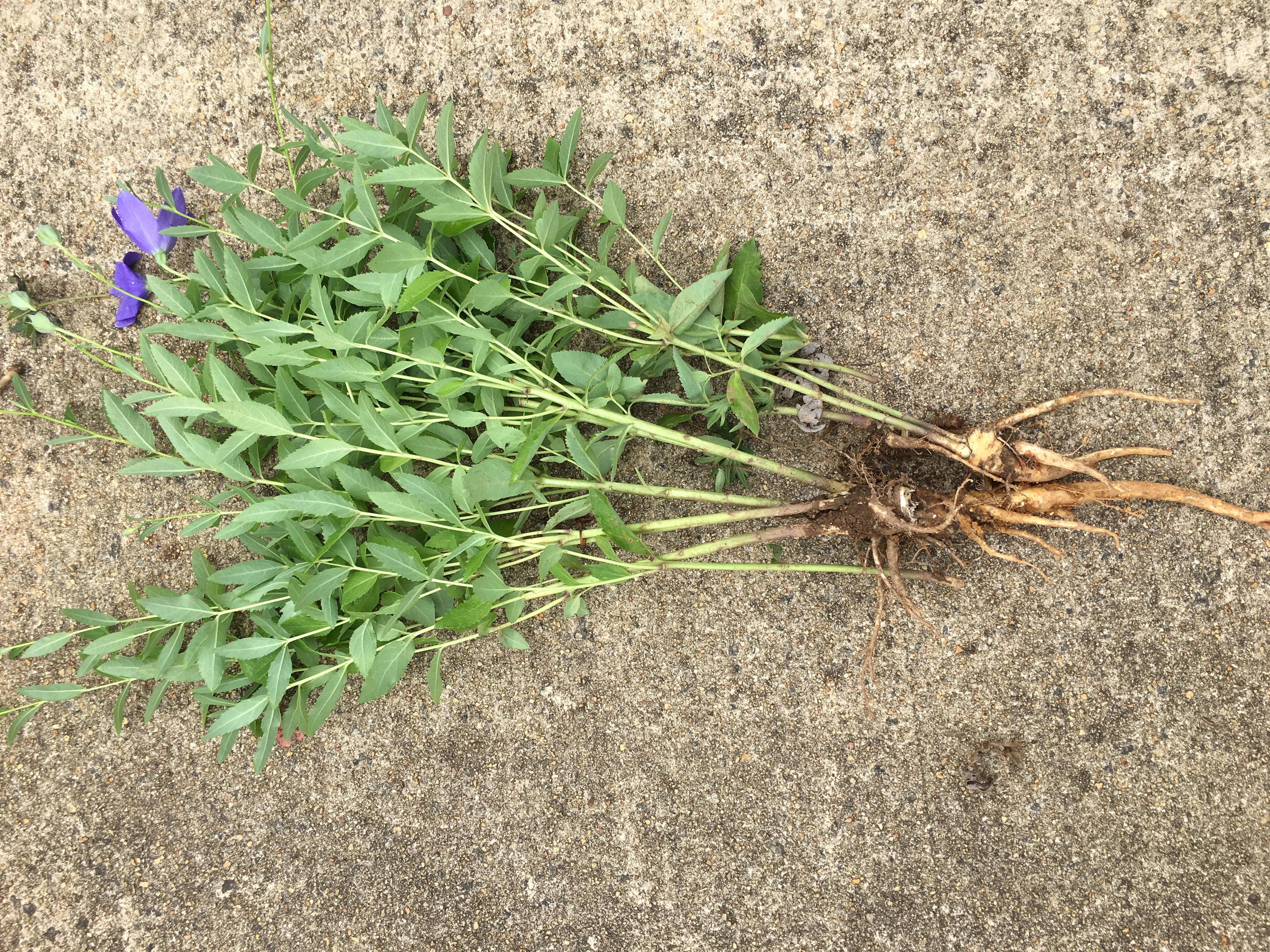
pulling to reveal tap root
Posted in Edibles, flowers, plants, seeds
Tagged balloon flower, doraji, invasive, Kitazawa Seed Company, Platycodon grandiflorus, weeds
The Virginia Cooperative Extension Master Gardener Program has produced a series of 10 short videos on YouTube about plant propagation. Filmed in the Virginia Tech greenhouses, each video is about 4 minutes or less. Topics include seeding, transplanting, grafting, air layering, tomato grafting, and the many different types of plant division. These will be helpful as you begin to start seeds indoors now or if you are interested in dividing and multiplying your houseplants.
Here is a handy chart courtesy of Seed Savers Exchange. Seeds or transplants of cool season veggies can be planted when the temperatures are at least 40 degrees, which is March and April in Virginia. There are two types of cool season veggies. Hardy types can withstand a heavy frost and temperatures as low as 40 degrees so they can be planted two to three weeks before the average last frost. In Northern Virginia, the average last frost date is between April 10 and 21 so I arbitrarily pick April 15 to be able to remember. That means that I can either directly sow seed into the ground the weekend of March 25 (because I work during the week) or (having started the seeds indoors) I can plant the small plants into the ground. Semi-hardy plants can withstand a light frost and prefer slightly warmer temperatures toward 50 degrees so they have to be planted later, two weeks before average last frost date which would be the weekend of April 1. If a severe temperature drop would to occur, I would protect the plants by covering them with empty 2-liter plastic soda bottles that had bottoms cut off.

 I updated my list of companies that produce seed catalogs on my seed catalogs tab. Note that a lot of catalogs are free (check their website), educational, and so visual — a great way to see the possibilities for this year’s growing season!
Seed Companies that mail print catalogs (online companies are listed at the end)
Adaptive Seeds http://www.adaptiveseeds.com
Baker Creek Heirloom Seed http://www.rareseeds.com
Botanical Interests http://www.botanicalinterests.com
Burpee http://www.burpee.com
Fedco Seeds http://www.fedcoseeds.com
Harris Seeds http://www.harrisseeds.com
High Mowing Seeds http://www.highmowingseeds.com
Hudson Valley Seed Library http://www.seedlibrary.org
John Scheepers Kitchen Garden Seeds http://www.kitchengardenseeds.com
Johnny’s Selected Seeds http://www.johnnyseeds.com
J.W. Jung Seed http://www.jungseed.com
Kitazawa Seed Company http://www.kitazawaseed.com
Park Seed http://www.parkseed.com
Peaceful Valley Farm and Garden Supply http://www.groworganic.com
R.H. Shumway http://www.rhshumway.com
Seeds of Change http://www.seedsofchange.com
Seed Savers Exchange http://www.seedsavers.org
Seeds from Italy http://www.growitalian.com
Select Seeds/Antique Flowers http://www.selectseeds.com
Southern Exposure Seed Exchange http://www.southernexposure.com
Sow True Seed http://www.sowtrueseed.com
Stokes Seeds http://www.stokeseeds.com
Territorial Seed Company http://www.territorialseed.com
Tomato Growers Supply Company http://www.tomatogrowers.com
Totally Tomatoes http://www.totallytomato.com
Urban Farmer http://www.ufseeds.com
Vermont Bean Seed http://www.vermontbean.com
Online Seed Companies
(companies that do not produce print catalog, order from web site)
American Meadows, Inc. http://www.americanmeadows.com
Renee’s Garden http://www.reneesgarden.com
Sample Seeds http://www.sampleseeds.com

Fall is Fantastic!
from Prides Corner Farms
It’s October — time to plant shrubs, trees, bulbs, and hardy perennials. Fall is a great time to plant in our area. The cooler temperatures, increased moisture, and decreased sun/heat allow the plants to settle in the ground, send out roots, and get established. While the soil is still warm, roots continue to develop until the ground actually freezes so the plant’s energy goes into getting firmly settled in the soil, not on top growth. The plants you buy now can be planted with minimal stress to them as well as to your wallet. Many garden centers are concerned with moving their inventory, especially the container grown plants that are outside. As winter approaches, discounts increase thus increasing the possibility of finding bargains.
Visit your garden center this month to enhance your landscape, support a healthy environment, and boost your well-being! For a list of garden centers in the Northern Virginia, Maryland, and Washington DC area, view the “nurseries” tab at the top of my website, http://www.pegplant.com.
Posted in Events, plants, seeds, vegetables
Tagged Autumn, bulbs, fall, Garden Centers, landscape, Nurseries, October, perennials, shrubs, trees

love-in-a-mist
I forgot to grow zinnias. Every year I grow zinnias so I can put a vase of flowers on my desk at work but for some odd reason, I didn’t this year. Now in the heat of summer I don’t have many options to choose from but next year I will grow zinnias for summer blooms and on top of that, will start even earlier with spring flowers.

dianthus
To learn more about increasing the diversity of flowers in my Northern Virginia garden, I have been following Lisa Mason Ziegler’s virtual book study for the past month. Each Friday for 10 Fridays, she posts a 10-minute video that corresponds to a chapter in her book, Cool Flowers: How to Grow and Enjoy Long-Blooming Hardy Annual Flowers Using Cool Weather Techniques. The videos can be viewed on her website any time and she is more than happy to answer questions. Lisa manages a commercial cut flower business in Newport News, Virginia. She is well known in the horticulture field, has written books and given lectures, and has an online garden shop called The Gardener’s Workshop. Lisa is an expert on hardy annuals, which prefer to bloom during spring’s cool temperatures. Hardy annuals differ from the summer annuals in that the seeds are sown in August/September or February/March, depending on the plant. In contrast, summer annuals, like zinnias, prefer the heat so they are sown after the danger of frost has passed in late April/early May.
Of the 30 plants mentioned in her book, I have seeds of six plants on hand. I can start snapdragon, dianthus, and feverfew indoors now and transplant at the end of August. I can direct sow love-in-a-mist, larkspur, and calendula seeds at the end of August to the beginning of September. All of these will bloom in the spring and peter out when summer arrives which will increase my number of cut flowers from spring to early summer. From then on the summer annuals can take over and I will look for a few more in addition to zinnias. In her videos and in her book, Lisa discusses her preference for direct sown versus transplants and starting in the fall versus early spring. If the plant is hardy to a zone colder than one’s own zone, plant in the fall. If the plant is not has hardy as one’s own zone, plant in early spring. However, early spring can mean cold, wet soil so she suggests preparing the bed in the fall and covering with mulch or landscape fabric to prevent weeds and to enable the ground to be worked easily in February and March.
So far I have viewed 5 of the 10 videos and I have read the book. If hardy annuals are something you would like to try, you can catch up by visiting her web site and listening to her videos or buy her book on her site or at a bookstore but it is not necessary to have the book in order to follow along with her videos.

mustard
August is the time for harvesting and enjoying the summer’s bounty in the vegetable garden while thinking ahead to a winter’s garden. Even though it is hot and humid, planting carrots, green onions (scallions), and cole crops such as cauliflower, broccoli, broccoli raab, Brussels sprouts, cabbage, and collards will give great yields in cold months. Later or by September, also consider planting spinach, Swiss chard, radish, turnip, and Asian or hardy greens such as mustard, tatsoi, mache, and kale. You still have time to plant garlic: that’s in October.
To determine when to plant look at the “days to maturity” on the seed packet. Count backwards from the average first frost date (Halloween in Northern Virginia) to determine when to plant. But the difference between fall and spring planting is the “Short Day” factor, which may not be addressed on the seed packet. If you are going to plant seed, you have to add 2 weeks to the numbers on the seed packet to allow for the cooler night temperatures and the shorter day lengths. For example, to sow spinach seeds add the 7 to 10 days for germination, 35 days to reach maturation, and 14 days for the Short Day factor for a total of 56 to 59 days. Therefore, the latest one can sow spinach seeds is the beginning of September. The length of time would be shorter if nursery transplants were used instead of seed because they have a head start.

mache
Also, find out the best temperature range for seed germination (start indoors versus outdoors), keep the seeds moist during dry times in the summer, and get to know each crop’s tolerance for cold (soil and air) to know if you should provide additional warmth with row covers.
Virginia Cooperative Extension
Vegetable Planting Guide and Recommended Dates #426-331
University of Maryland Extension
Planting Dates for Vegetable Crops in Maryland #HG16
Vegetable Planting Calendar for Central Maryland #GE-007
Southern Exposure Seed Exchange
Southern Exposure Seed Exchange is a Virginia-based seed company that also has very useful local information:
Posted in Edibles, plants, seeds, vegetables
Tagged August, Fall garden, winter garden

Cardinal climber among oregano and sage
July is a good time to take stock of the garden and determine what worked and what didn’t. This year I tried growing cardinal climber because I have banisters and rails in several locations on my property. Cardinal climber (Ipomoea x multifida) is a flowering vine, grown as an annual in Virginia. It is easy to grow indoors in the spring from seed which I obtained from Renee’s Garden. In May, I transplanted them outside and trained them up to the banisters with yarn. They learned quickly and began to wrap themselves around the banisters. Now that it is hot, they bloom every day in full sun. The flowers are bright red and simple but I discovered that they add a pop of color against the other plants. The leaves are very lacy and the vines are light enough to weave into neighboring plants (I like it when two or more plants tumble into each other’s space). Cardinal climber is a winner in my book.

Vanilla Cream marigold with Cossack Pineapple ground cherry
The other winner flower this year is ‘Vanilla Cream’, part of the Alumia series of French marigolds from Park’s Seed. I started the seed indoors in the spring although it was not necessary, I could have started them outside later. In May I plant them outside in a row in front of a vegetable bed so the lawn service crew wouldn’t get too close to the veggies with the weed wacker. The marigold plants have filled out nicely. Each bushy plant has several blooms at a time. The flowers are unusual for a marigold, they are anemone-shaped and bright yellow. I like the fact that they are a clear solid yellow — they glow like beacons in the garden.

husks pulled back from ground cherry fruit on spoon
Speaking of yellow, this year I grew Cossack Pineapple ground cherries. I bought seed from the Southern Exposure Seed Exchange and started them indoors under lights in very early spring. I was surprised at how well they germinated. In May, I transplanted several in my tomato patch and although I thought I gave them enough space I did not realize how fast they grew. Mine are a few feet wide and tall and completely cover the ground. Members of the tomato family, the fruit is small like a pea covered in a papery husk. The husks are green on the plant and gradually turn yellow and drop to the ground. I have learned that some of the ones on the ground are empty, maybe something got to them before I did, so I gather the ones on the ground and gently touch the yellow ones on the plant to see if they will drop into my hand. The fruit really does taste like pineapple but without the zing so more like a cross between a pineapple and an apple. They can be eaten raw, used in desserts, or used in savory dishes like salsa.
These are just a few success stories in my garden, more to come!