Subscribe to a Free Gardening Newsletter

Subscribe to Pegplant’s Post Gardening Newsletter, a free monthly newsletter about gardening in the VA, MD, DC metro area. Enter your e-mail here to subscribe. Each monthly issue lists 50-100 local gardening events, recently published gardening books, articles, tips, and news specific to this area. Pegplant’s Post Gardening Newsletter always has a giveaway, an opportunity to win a free plant or gardening-related product. For the upcoming June 2023 issue of Pegplant’s Post, the giveaway is a combination of four gardening products: sprayer, watering can, cultivator, and plastic tote, all courtesy of Crescent Garden.

Crescent Garden has been in business for more than 20 years and is one of the premier container gardening providers. Headquartered in Miami, Crescent Garden is a pioneer in self-watering solutions. Crescent Garden developed the Trudrop self-watering planters that enable gardeners to easily determine when to water. Containers are available in a variety of sizes, colors and shapes for both indoor and outdoor plants. In addition to containers, Crescent Garden sells gardening tools, sprayers, watering cans, outdoor tableware, and accessories such as planter saucers and tote bags. The informative website has a blog and there are both wholesale and retail catalogs.

If you don’t already subscribe, subscribe now to the free Pegplant’s Post Gardening Newsletter to be eligible to win this fantastic giveaway!

Sweet Potato Twists

Sweet potato

Sweet potatoes are botanically different from white potatoes. Sweet potatoes (Ipomoea batatas) are in the morning glory family while white potatoes (Solanum tuberosum) are in the nightshade family. Both produce tubers but sweet potatoes are planted in the summer and harvested in the fall, while white potatoes are planted in the early spring and harvested in the summer. Sweet potatoes need a long growing season, at least 4 months, and thrive in our hot and humid summers here in the DC metro area.

While white potato plants are started with chunks of the tuber, sweet potatoes are grown from rooted sprouts called slips. Slips may look like limp, short stems with no roots. If you order slips, plant them when the soil has warmed to at least 60 degrees and nighttime temperatures are above 60 degrees. If it is too cold, pot them up and hold them inside near a sunny window.

Plant slips about a foot part, covering with soil up until the first pair of leaves. These plants are usually grown in the ground, in loose, well-drained soil. These plants are vines that grow several feet long so give them plenty of space. The green, heart-shaped leaves are edible (deer like them too). The plants will grow up until frost and the tubers should be harvested before the first heavy frost.

Sweet Caroline Sweetheart Red ornamental sweet potato

Ornamental sweet potato plants are grown for beautiful foliage in a wide range of colors. Ornamental sweet potato plants can have chartreuse, dark purple, bronze-red, mahogany red, or variegated cream, green, and red colored leaves. These are used frequently in containers in public spaces and gardens because the vines are ideal “trailers,” draping over containers. Since they are tropical plants, they tolerate our hot summers and add quite a lot of color. These are easy to find at local garden centers and are sold as small annuals in cell packs.

There is a relatively new line of sweet potato plants that have beautiful ornamental foliage (still edible) and produce tubers for harvest. Treasure Island Sweet Potatoes have been bred by Louisiana State University AgCenter from an original concept development and collaboration work by their partner FitzGerald Nurseries in Ireland. These plants can be grown in a container in the summer for colorful leaves and the tubers can be harvested in the fall. The plants in the Treasure Island series are named after different Polynesian Islands because each plant “hides” a treasure underneath the soil.

There are five plants:
Tahiti, green leaves and purple tubers
Tatakoto, dark green purple leaves and orange tubers
Makatea, golden green foliage and white tubers
Kaukura, purple foliage and orange tubers
Manihi, dark purple foliage and orange tubers.

These new plants would make an ideal children’s gardening project and vegetable container plant for those with limited space.

Either way you slice it, sweet potatoes are great additions for the garden. Try growing some this year!

Carolina Allspice: Native, Deer-resistant, Summer-flowering Shrub

I have always admired Carolina allspice (Calycanthus floridus), a deciduous shrub that flowers in the summer.  This is such a beautiful plant I don’t know why other people don’t grow it more often. Native to the southeast region, Carolina allspice grows 5 to 8 feet tall, is deer resistant, and has no major pests and/or diseases.

The green leaves are relatively large for such a small bush. The mahogany red flowers bloom all summer long.  Pollinated by beetles, the 2-inch flowers look like a cross between a star magnolia (outer strap-shaped petals) and a lotus (curved inner petals with a central, raised button). In the fall, the leaves turn golden yellow.

These are understory shrubs meaning that they prefer to grow under the shade of tree canopy. Mine is under mulberry trees, or rather weeds, so it receives partial sun. They are well branched and respond well to pruning. They do not seem to be fussy about the soil other than wanting well drained soil.

Since 2016, my cultivar ‘Aphrodite’ has performed well and is in full bloom this month. The flowers are redder than the species and are supposed to smell like apples. I don’t detect this outside but if I were to cut them and bring them inside, the heat of the house seems to make them more fragrant.

The flowers can be cut for arrangements or for water bowls. When it was young, the flowers did not have a scent but I had read that young plants do not always have a fragrance. Apparently this attribute comes with maturity. The flower scent varies with plant so the other cultivars below may have a slightly different fragrance although they are all pleasant.

The leaves, bark and root are equally fragrant but more like camphor. If you crush the leaves or scratch the bark, there is a pleasant, almost lemony, camphor scent which reminds me of a friend who would put eucalyptus branches in her car for the heat to release the pleasant scent.

Mark Catesby, an English botanist who traveled the New World is credited with introducing the shrub during his colonial explorations. He said the bark was as “odoriferous as cinnamon” although I think the scent is more like a cross between lemon and camphor.  The dried flowers, leaves, and branches can be used for potpourris.

Carolina allspice is a great shrub for the Washington DC metro area. I recommend ‘Aphrodite’ but there are other cultivars on the market as well such as:
Athens: yellow chartreuse flowers
Burgundy Spice: burgundy colored flowers and leaves
Venus: white flowers and is more compact
Hartlage Wine: red blossoms with small yellow markings and larger at 12 feet.

Look for this at your local garden center and add one or two to your garden. You will be pleasantly surprised!

Growing Cilantro From Seed in the Summer

cilantro

Cilantro in early spring

I love cilantro and I plant it every year. It is easy to grow from seed although one can find small plants at local nurseries. Cilantro (Coriandrum sativum) is a member of the carrot family. Because of its tap root, it is best to sow seeds directly in the garden bed or in a container. Often called Chinese parsley, the leaves do look like parsley but if you rub the foliage you will smell a citrusy/woodsy scent.

In the beginning of April, I sow the seed in the ground and in containers on the deck. In early spring, this particular patch in the ground and the containers are in full sun. The seeds germinate in a week to 10 days. The plant grows to about one foot tall and the leaves are broad with scalloped edges. In late April and early May, I harvest the foliage for a variety of dishes. We like to use fresh cilantro for beef empanadas, fried rice, enchiladas, tacos, and salsa.

By late May, beginning of June, the leaves alter their shape to be thin, finely dissected, and lacy. Flower stalks emerge and small white flowers appear. Soon the plant sets seed, which are small, tan balls. These are known as coriander. I clip these off and put in a paper bag to sow next year. Although they are a spice that can be used in the kitchen, I tend to save them to sow again.

cilantro

Cilantro bolting and sending up a flower stalk

Because my original spring cilantro plants have expired before summer tomatoes have even appeared, I sow seeds again. However, cilantro is a cool season annual. For these plants to grow in Virginia’s hot summer, I have to change the environmental conditions to mimic spring.

Cilantro likes cool temperatures and relatively moist soil. This happens naturally in the spring, but in the summer, that means I need to provide morning sun and afternoon shade or dappled shade. This will decrease the summer’s heat. The soil needs to drain well yet be high in organic matter. If it does not rain for a while, I will have to water the plants with a hose. I have to constantly be aware of soil moisture and rain.

In the summer, I sow the seeds in a different place in the garden, a place with afternoon shade. If one cannot provide shade, consider buying a shade cloth or grow in containers that can be placed under trees. I also sow the seeds in containers on the deck where there is a tree because it is easier (i.e., takes less time) to walk out on to the deck from the kitchen door and monitor the plants. It takes more time to walk into the garden so I do both in case I get too busy. Gardening is a gamble; it is a high stakes game. The more you sow in a variety of places, the higher the likelihood that something will germinate and grow so you can enjoy the harvest.

cilantro

Cilantro flowers

I sow seeds every few weeks. With the high summer temperatures, the plants will bolt even quicker than in the spring. Thus, I have a narrow window of opportunity to harvest leaves from a planting.

One trick to having fresh cilantro all summer long is to continue to sow the seeds in as cool a place as you can manage. Another trick is to use varieties that are known to be slower to bolt. They will still bolt but you may be able to delay it a few weeks. Try Santo, Caribe, Calypso, Slo Bolt, Leisure, or Longstanding. You may have to order the seed packets online; it is likely your local nursery will not carry these. Check out these seed companies.

coriander

Cilantro seeds, also known as coriander

Some people get tired of this real quick and just give up during the summer. This is fine too; it does take more time and diligence to grow cilantro in the summer. Remember though that fall conditions are like spring, cool and moist. Try sowing seeds in September to have foliage in the fall. Because cilantro is resistant to a light frost, you can sow seeds every few weeks and then protect with a row cover, low tunnel, or a cold frame to harvest up until the holidays.

In the DC metro area, one can continue to purchase small cilantro transplants at local nurseries to plant in the garden. You can also purchase fresh cilantro at many grocery stores in this area. I like a challenge, though, and I like to be able to walk out to the garden and snip fresh cilantro whenever I need it. Try growing cilantro from seed this year.

Native Fringe Tree with Showy Spring Flowers

If you live in the Washington DC metro area, you may be seeing fringe trees blooming now — its wispy cream flowers, like an old man’s beard, swaying in the breeze. Fringe trees (Chionanthus virginicus) are native, deciduous trees that prefer full sun to part shade and moist fertile soil. Their natural habitats are damp woodlands. Fringe trees are named after their sweetly scented flowers, comprised of 4 to 6 one-inch long straps. Although fringe trees are dioecious (male and female plants), they both flower. Some produce what are called “perfect” flowers (having both male and female parts). Therefore, female flowers and perfect flowers produce fruit that resemble dark blue olives. Fringe trees belong to the olive family and the birds love the fruit. These slow growing trees mature around 15 to 20 feet and are perfect for the home as specimen trees.


Learn More About Gardening in the DC Metro Area

Learn more about gardening in the DC metro area by subscribing to Pegplant’s Post Gardening Newsletter, a free monthly newsletter. Enter your e-mail here to subscribe. Each monthly issue lists 50-100 local gardening events, recently published gardening books, articles, tips, and news specific to this area. Pegplant’s Post Gardening Newsletter always has a plant or gardening-related giveaway. For the upcoming May 2023 issue of Pegplant’s Post, the giveaway is Scindapsus ‘Sterling Silver’, a houseplant courtesy of Costa Farms.

Costa Farms is one of the largest horticultural growers in the world. It is a fourth generation, family-run company that started in 1961 when Jose Costa Senior purchased 30 acres to grow tomatoes in the winter and calamondin citrus in the summer. Soon he was growing houseplants and now the company has expanded into annuals, perennials, and tropical plants for the garden. Costa Farms has an upbeat website, full of videos, and all the information you need to grow each houseplant. There is a plant finder to help you locate the perfect houseplant for your needs; a free, subscription-based newsletter; and staff dedicated to answering customers’ plant questions.

Scindapsus ‘Sterling Silver’ is a member of the aroid family, cousin to pothos, philodendron, and monstera. This is an easy to grow houseplant with silvery, heart-shaped foliage. It can be grown as a climbing, trailing, or table-top plant. Prefers bright light, tolerates medium light.

If you don’t already subscribe, subscribe now to the free Pegplant’s Post Gardening Newsletter to be eligible to win this fantastic giveaway!

Twenty-One Tips for Growing Tomatoes Successfully

By now you should have started your tomato seeds indoors under lights. This is just if you want a head start of course, it is not necessary. You can also purchase tomato plants but be aware that the night temperatures are still cold for them to be out in the garden now. They prefer warmer weather. Waiting to plant tomatoes until the beginning of May or Mother’s Day will give you the best results. For tomato success, read these twenty tips for growing tomatoes in the Washington DC metro area.

First, know what you grow. Tomatoes have determinate or indeterminate growth habit. Determinate types produce fruit at the end of the branches so most of the crop ripens at one time and you will have one or two harvests per growing season. This is advantageous for canning. The determinate types are more compact and are better for containers than the indeterminate tomato plants; however, you may still have to stake the vines or add a trellis. Indeterminate plants produce fruit along the branches so you can pick tomatoes all season long. They can be large, vining plants; a support system such as hoops or stakes should be used.

Sun Dipper, from PanAmerican Seed Handpicked Vegetables.

2. Tomatoes come in many sizes, shapes, colors, and flavors. Grow what you like to eat or use in the kitchen. For example, determine if you prefer to use tomatoes for salad, snacking, pasta sauce, sandwiches, etc. There are more specialized varieties for specific uses such as the Sun Dipper pictured to the right which is elongated to make it easier to hold while dipping into a dip.

3. If you are limited to containers, grow the determinate type and use a container at least 5 gallons large with drainage holes or an Earthbox. Or look for varieties especially bred for containers such as window box types (usually these will be the small, cherry types).

4. Determine if growing an heirloom plant is particularly important to you. Heirlooms may be tastier, and seeds can be saved for next year, but these plants may be more susceptible to diseases. Hybrids are often bred to be disease resistant. However, if you save and sow the seed next year, the plants may not have the same traits as before. Seed catalogs and packages often have letters after the plant’s name to indicate disease resistance. For example, F is for fusarium, V for verticillium, LB for late blight, TMV for tobacco mosaic virus, and N for nematodes.

tomato

Early Girl gives you fruit earlier than most other tomato plants, photo courtesy of Ball Horticultural Company

5. Days to maturity is the number of days it will take on average for a transplant to produce a tomato (fruit) when planted in the beginning of the summer. It is not the number of days from seed. This varies quite a lot with tomatoes from plants with a lower number of days which will provide an early season harvest, to mid-season, to those with larger numbers, resulting in a late season harvest in late summer. If you have the space and want tomatoes throughout the growing season, you can plant early, mid, and late season plants.

6. If starting from seed, sow seeds about a month before average last frost date (Mother’s Day here). Start inside under lights. When the seedlings produce a set of true leaves, you can pot up the plant into a larger container and put outside for a few hours a day. Gradually introduce seedlings to more daylight and more time outside in order to harden off before putting in the ground. Hardening off is the process of acclimatizing seedlings to higher light levels, cooler (than your home) temperatures, and breezes so they can withstand being outside. Here is a link to tips for starting seeds indoors.

7. At first the nighttime temperatures may be too cold (forties and below) to leave these transplants outside so you may have to bring the pots inside for the night.

8. Seedlings and transplants in the spring may develop purple tinged leaves which means cool temperatures are preventing phosphorus absorption. In the summer, when it gets warmer, they will grow out of this so no need to do anything.

tomato

The purple coloring on Indigo sun tomato is intentional, it is a higher level of anthocyanins, which is healthy for you, photo courtesy of Ball Horticultural Company

9. Tomato plants need at least six hours of sun and like warm soil, which is why it is best to put the transplant in the ground after Mother’s Day. If you plant them in cold soil, they will sit, unhappy.

10. Tomatoes like fertile, well-composted soil, not clay. In this area, you may have to amend your garden bed with compost. In the spring, a raised bed and a container will have warmer soil than the ground.

11. When nighttime temperatures are in fifties and the transplant is hardened off, plant in ground. For the indeterminate types, insert staking or hoops immediately after planting. Make sure you have spaced your tomato plants so there is a minimum of 2 feet apart for air circulation (to decrease a pathogen’s ability to spread).

12. Tomato stems will develop roots if covered with soil. Some gardeners will bury as much stem as possible to encourage root production. The theory is that if there are more roots, the plant will be able to take up more water and nutrients. Some people lay the transplant down on the ground, horizontally, burying the stem, but leaving 1 to 2 set of leaves above ground. Some people plant vertically, but very deep, leaving 1 to 2 sets of leaves above ground. Before you submerge the stem, strip off the leaves and little branches that would be underground.

13. A lot of gardeners add calcium in the form of crushed eggshells to the soil or 1/4 cup of lime before planting to prevent blossom end rot. If you do not do this, then pick a fertilizer especially formulated for tomatoes because it should have the added calcium.

14. In the beginning of the summer, mulch with straw, leaves, or compost to prevent weeds and to keep a constant level of soil temperature and moisture. Try Maryland’s Leaf-Gro; do not use composted manure.

15. Tomatoes will need to be watered so make sure a hose or watering can is available. Water the soil, not the plant, and water in the morning to decrease possibility of fungal disease. It isn’t that tomato plants need a lot of water, it is that the soil moisture must be consistent, and not fluctuate often. Mulching helps with this.

tomato

Think of how much water, sun and fertilizer it will take to produce this large slicer, Beefmaster. Photo courtesy of Ball Horticultural Company.

16. In mid-summer, tomatoes will need to be fertilized, especially if grown in containers. Espoma has organic Tomato-Tone and Neptune’s Harvest has a Tomato and Vegetable Formula.

17. To obtain fruit, temperatures must be above 55 degrees at night but temperatures of 75 or higher will inhibit fruit set and may cause blossoms to drop. However, there are heat-tolerant varieties.

18. Tomatoes are wind pollinated. Some gardeners hand-pollinate with a paintbrush if they feel the plant is not setting fruit. All the more reason why there should be good air circulation. Harvest frequently to encourage plants to produce fruit.

19. Pruning is optional, but only indeterminate plants should be pruned. Pruning here refers to removing the side shoots or suckers. Some gardeners do this to increase or to have more uniform fruit size and to help tomatoes ripen faster. It will not increase the number of tomatoes. If prune, start when plants are about 2 feet tall and suckers are small. Do this when the plant is dry, not wet from rain.

20. If possible rotate crops to prevent soil-borne diseases. If your tomato plants are having problems, check out the Virginia Tech Extension site on growing tomatoes, tomato diseases, and tomato pests; and the University of Maryland Extension site on tomato diseases, pests, and nutritional issues, growing tomatoes, and tomato topics; or contact your local extension agent.

21. Pick the fruit when it begins to color and bring inside. Ripen at room temperature and do not put in the refrigerator. This also prevents animals from eating the fruit before you do.

Garden Battles: Cabbage Worm

cabbageworm butterfly on kale

cabbage worm butterfly on kale

I was harvesting my lettuce when a flash of white flitted by the kale. My heart stopped: it was the dreaded cabbage worm.

Last year, I spent an enormous amount of time fighting imported cabbage worm. The white butterflies, the adult form, are attracted to members of the cabbage family. In my garden, that means mustard and kale. The small, white butterflies lay yellow, bullet-shaped eggs under the leaves. Within a few weeks, the larva, the disgusting green worms, decimate leaves and stems. They then pupate and more adults emerge so within a growing season there are several generations. Surprisingly, they can continue all year long on my property in Northern Virginia.

cabbageworm butterfly near lettuce

cabbage worm butterfly on lettuce

At first, I tried picking the worms off but quickly concluded that: first, it’s gross; and second, it’s easier said than done. It is difficult to pick them up on a continuous basis because we are all busy.  It seems eggs are always hatching, larvae are always present from very tiny to very large, and the green color of the worm blends in with the green leaves.

I know the other recommendation is to use row covers but I live in a traditional suburban home and my kale and mustard plants are in pots on the deck or tucked in the landscape, not in rows. I do not have the type of vegetable garden where there are rows of one crop.

Finally, I resorted to Thuricide®, a liquid form of Bacillus thuringiensis (Bt), thinking that I would just have to spray once or twice. Bt is a bacteria that kills the larvae so it is a non-toxic, biological insecticide. However, it got to the point where I felt that all I was doing was spraying instead of growing and eating.

By the end of the year, I was fed up and vowed not to grow kale and mustard again. Then I thought what if I grew the colored mustards as a winter annual in a container? For sure the cabbage worms could not be active in the winter.

But yes, Virginia, they were very active in the winter and ate the mustard as if it were a summer delicacy. Do you have this problem in the garden and if so, what do you do to battle the cabbage worm?

Flowering Bleeding Hearts Are a Sign of Spring

Bleeding hearts are beautiful spring blooming plants. They have green, fern-like leaves and nodding racemes of pendulous blossoms.

Each blossom looks like an earring or a puffy locket on a chain. The blossom is comprised of two outer rose-colored petals and the two inner white petals. If you turn the flower upside down and pull the rose petals apart you will see the lady in a bath. Lady-in-a-bath is another common name for this beautiful plant.

Bleeding heart is an herbaceous perennial that prefers moist soil, high in organic matter (think woodsy). Some shade is best, can be morning sun and afternoon shade or dappled light. With such delicate foliage, you would think that rabbits and deer would decimate bleeding hearts but neither seem interested in my Virginia garden.

These plants emerge in March and bloom in April and May. By June, the leaves have turned yellow and ratty and eventually the plant disappears. It becomes dormant in the summer. In order to prevent a gap in the garden, you can plant other herbaceous perennials such as hardy geraniums or hostas nearby or summer annuals in its place.

There are different cultivars on the market. ‘Alba’ has all white flowers against green foliage. ‘Gold Heart’ has yellow foliage that really brightens up a shady corner and ‘Valentine’ is striking with its cherry-red flowers and red-brown stems.

Try growing bleeding hearts. The plants are very easy to find at local garden centers but you can also dig and divide an established plant if you know someone who has one in their garden.

Growing and Cooking with Oregano and Marjoram

Flowering Greek Oregano

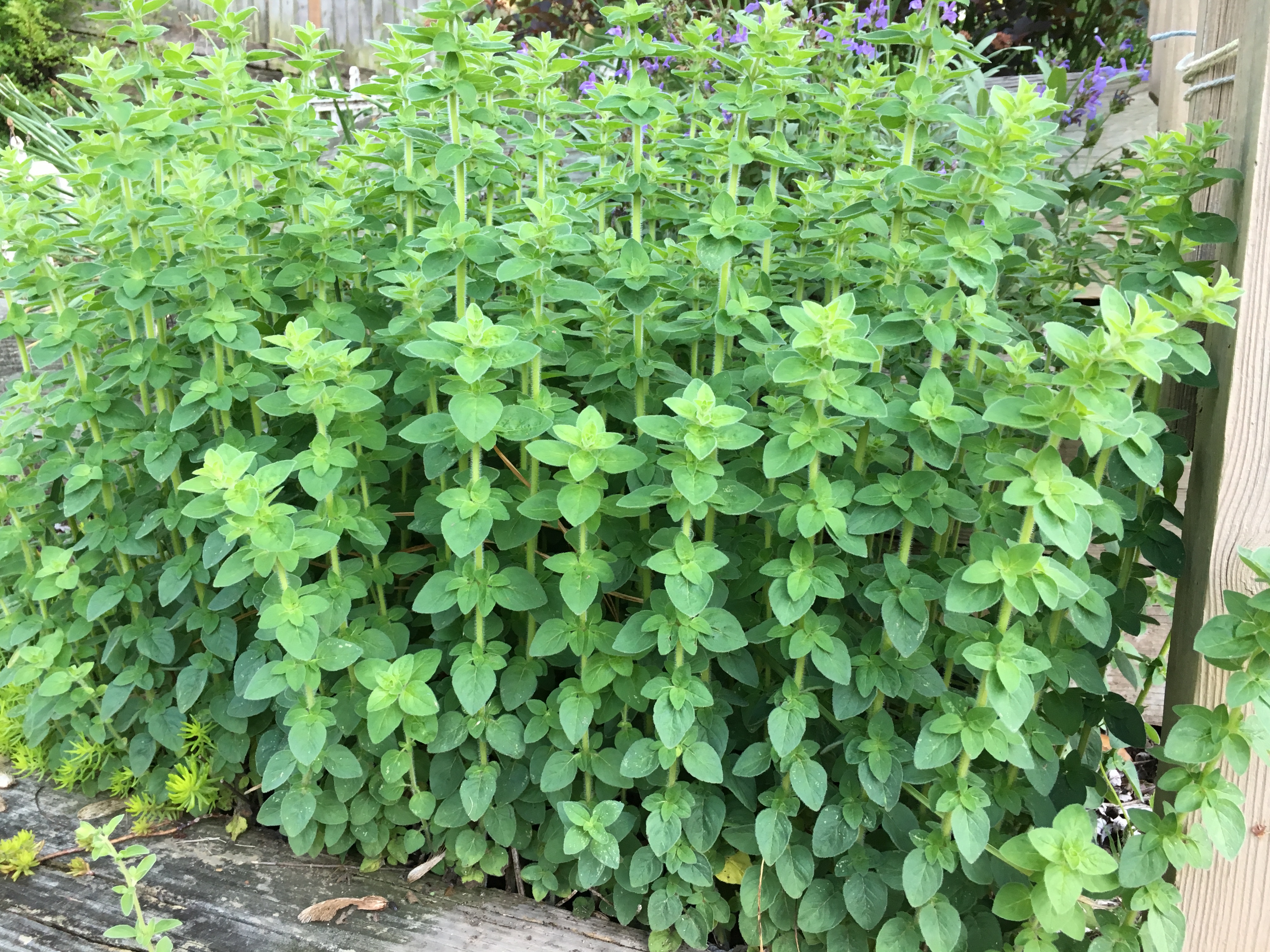
This week I was in the garden, cutting back the old flower stalks from my oregano. I love seeing the new growth in the spring. Nearby is the marjoram, also flushed with new green growth. Now, before they flower, is a good time to harvest the leaves and either use fresh or dry them for future use.

The Origanum genus is in the mint family, Lamiaceae. There are more than 40 species and many varieties and hybrids – they cross pollinate easily. All have typical “mint” flowers: bilaterally symmetrical with five united petals that create an upper and a lower lip. The small flowers occur in spikes and attract beneficial insects and pollinators. Some plants have bracts or modified leaves that are more pronounced and colorful than others (poinsettia and bougainvillea are examples of colorful bracts that look like flowers but are not true flowers). They all have hairy stems and leaves and again, some more so than others.

Of the culinary herbs in the Origanum genus, all hail from the Mediterranean area, thus requiring full sun, well-drained soil, and good air circulation. Not all are hardy here in the mid-Atlantic area but they are all deer resistant because of their chemical constitution. These plants have two primary chemicals: carvacrol and sabinene hydrate. Some have thymol. Carvacrol is responsible for the pungent, peppery flavor you know so well from “pizza oregano.” It is a creosote-scented phenol with antibacterial and antifungal properties. The amount in each plant varies.

If you are purchasing a plant for culinary use, crush a leaf, and smell and eat it first before you purchase the plant. You want to ensure it has the right amount of carvacrol for your palate. You want to do this so you don’t accidently purchase Origanum vulgare, which is a common oregano type plant that has naturalized in this area. Although edible, it is not considered “tasty” because of its low level of carvacrol. It can still be grown as an ornamental in the garden and has small pink flowers (not white) in the summer.

Baby oregano popping up among the sedum

For the best flavor, buy Origanum vulgare subsp. hirtum, which is Greek oregano, or Origanum x majoricum, which is Italian oregano. Both have a high levels of carvacrol. Both are hardy to this area and make great landscape plants. These plants have small white flowers on inch-long terminal flower structures and provide greenery above ground in the winter.

Greek oregano’s new spring growth

I have Greek oregano. From spring to summer, there is new growth and the stems grow upright. If I were to cut the leaves now to use in the kitchen, it will rebound quickly and then I let mine flower. By summer, the branches topple over with the weight of the flowers. The area is surrounded by insects and bees. By late fall it gets a little ratty looking. Usually I leave it as is over the winter.  The plant remains above ground in the winter and the foliage turns purple. Every year, a baby plant pops up in the front garden which is easy to pull and either throw away or pot up and give to a friend.

Greek oregano bending under the flowers’ weight

I was given ‘Hot and Spicy’ which is a cultivar of Greek oregano. I find it too pungent and peppery so I grow it in the backyard, against the tool shed. It receives morning shade and afternoon sun but still flowers. I don’t harvest it, I just let it flower to attract the pollinators for my vegetables nearby.

Next to my Greek oregano is sweet or knot marjoram. Marjoram has a low level of carvacrol and but a high level of sabinene hydrate, which is more of a fruity flavor. Marjoram is so sweet it is used in perfume as well as baking and cooking. In the past, marjoram was employed as a strewing herb, incorporated in potpourris and sachets, and used to scent linen closets and hope chests. It is called knot marjoram because the flower buds are knots; like knots used as buttons on shirts.

Marjoram is considered a tender perennial and should not survive our winters but mine has lived for many years in my Virginia, zone 7 garden. I am sure it is because it is in full sun on a terraced area so it has very good drainage and warmth from the south side of the house. Marjoram grows like the Greek oregano. By fall the branches bow down with the weight of the flowers, also surrounded by insects. However, in the winter, the foliage is green, not purple, and I have never seen a baby marjoram pop up in the garden. 

Knot marjoram’s flower buds are “knots”

If you do not have a garden, these plants can be grown in containers for the summer. Make sure the container is in full sun and large enough with drainage holes. You may have to water more often than if they were in the ground.

In the kitchen, you can use fresh or dried foliage from these plants. The herb flavor is always stronger in dried leaves so use less of the dried than of the fresh leaves. These plants add flavor to yeast breads/rolls, savory scones with cheese, focaccia, garlic bread, egg dishes, bean dishes, tomato-based dishes, potatoes, cornbread/muffins, and corn or tomato soup. They pair well with thyme and/or lemon or olive oil or garlic and/or lemon. You can make a rub by mixing with other herbs to rub over chicken, turkey, or pork before roasting. You can also add to stuffing or dressing. The branches can be used to decorate a turkey platter or a side dish.

Try growing marjoram and oregano in your garden this summer. You will enjoy their flavor in your dishes and you will be able to support pollinators and beneficial insects in the garden. For more information on purchasing and growing herbs in the DC metro area, as well as herb cookbooks, click here. If you are interested in learning more about culinary herbs, join the Facebook group called Culinary Herbs and Spices or join the Potomac Unit of the Herb Society of America.