Category Archives: plants

Curious Garden Exhibit at the Atlanta Botanical Garden

Recently I visited the Atlanta Botanical Garden in Georgia and was fortunate to catch the Curious Garden exhibit. I could only stay for a few hours in the morning so was not able to see everything but the garden itself was lovely, the weather was relatively mild for an Atlanta summer day, and the staff were very friendly.  I have never been to the Atlanta Botanical Garden before and did not even know about the Curious Garden exhibit so it was a real paradigm shift for me to see so much art in the garden.

Designed by Adam Schwerner, a horticulturist and artist, the Curious Garden exhibit has 11 installations created to highlight the gardens’ plant collection and plant conservation work.  Currently, Adam is the Director of Resort Horticulture and Resource Enhancement at Disneyland but when he was Director of the Chicago Park District Department of Cultural and Natural Resources, he spearheaded an initiative to bring together the arts and nature in the Chicago parks. His famed Painted Tree Project brought together works of art in a public space that enhanced the environment. These unusual expressions known as Artscapes spark conversation among the public and make them see nature and plants through a different lens. This certainly was true for me at the Atlanta Botanical Garden. Adam’s creations were installed in May and will run through October so if you get a chance to visit Atlanta, don’t miss this.

Although I took many photos of the Atlanta Botanical Garden, which I will post in a separate article, these photos are just a few of Adam’s installations to give you a flavor of his work.

The spirited bosk, painted maple trees, planted and hung from larger trees

The mountain flows, the river sits, a “river” of red-painted gourds

The white garden, a garden of white flowered and silver leaved plants

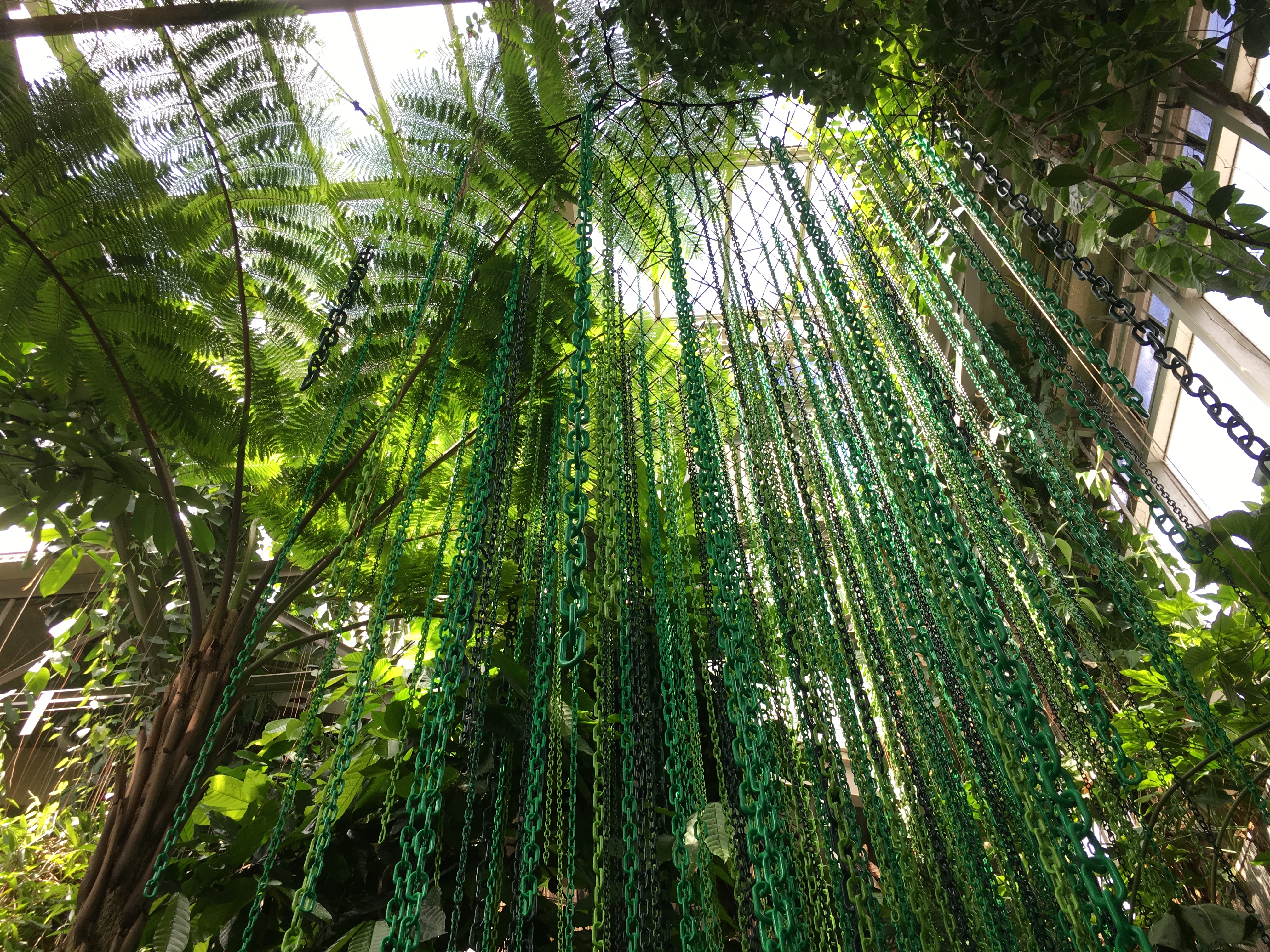
Chains, metal painted chains and roots of a plant in a conservatory

Antebellum aerophyte, chandeliers draped with bromeliads and Spanish moss

Chalices, small pots of orchids stacked on top of each other

Sunflowers, sunflower plants interspersed with cosmos


Invasive Balloon Flower Takes Over the Garden

Today I tweeted that it would be good to pull weeds since it had rained buckets for the past few days, thus decreasing the heat and humidity and loosening the soil. For me, the time was ripe to pull an invasive plant from my garden, balloon flower (Platycodon grandiflorus). “Balloon flowers?” you say, “but it has such pretty blue flowers and the kids love to pop those inflated buds.” Yes, my kids did like to pop the buds on my original plants as they walked to the front door and yes, they do produce pretty blue flowers on tall stems all summer long. But after 10 years, the kids don’t see them anymore (because their heads are always bent down viewing their iPhones) and the original four have multiplied into hundreds, crowding out my other perennials in my Virginia garden.

original four plants have multiplied on left side of walkway and have tan seed pods (directly across walkway is one balloon flower from front garden bed)

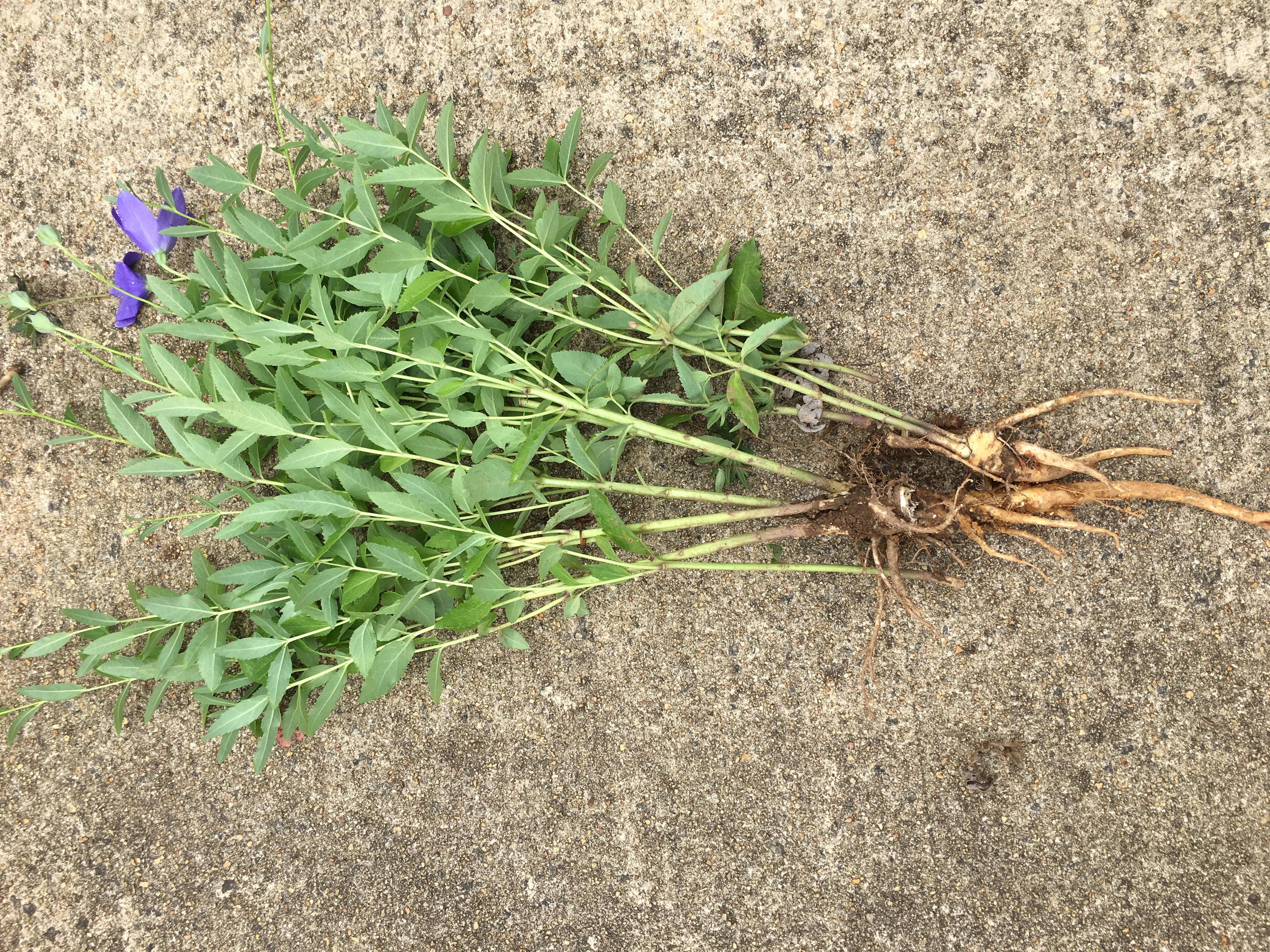
Part of problem is that balloon flowers self-seed very fast. The plants could be deadheaded to prevent self-seeding but this is a nerve racking, time consuming task. Each single seed pod has to be clipped off in order to leave the remaining buds or open blossoms. It is not possible to whack the entire plants down a foot. And part of the problem is that they are deer-resistant, drought-resistant, and generally pest free but the worst part is that balloon flowers have long, large tap roots. Breaking off the stem just encourages more stems to grow from the root. Although it is easier to pull and dig after it rains, I still spent hours pulling and digging to get the whole roots out as much as I could. I suspect I did not dig deep enough though, there probably are pieces in the soil that will rise again like the phoenix.

seeds landed on front strip across walkway (blooming with blue flowers)

Interestingly, I have found little reference to its invasive attribute on the internet. I did learn that the Kitazawa Seed Company catalog sells them and according to their description, the root, called doraji, is used in Korean cuisine. It is also used as an anti-inflammatory to treat colds and is considered a cheap ginseng substitute. The root can be dried and packaged for sale in Asian markets.

Unless you want to grow your own doraji for medicinal or culinary reasons, don’t plant this invasive perennial in your garden no matter how much fun you have popping the balloons.

pulling to reveal tap root


Letting Your Herbs Flower to Attract Beneficial Insects

My first guest post for the Herb Society of America’s blog appeared yesterday. I was inspired by the numerous beneficial insects hovering around my herbs in my Virginia garden. Often my herbs flower before I ever get to harvest the leaves but that’s okay because their tiny flowers attract the “good” bugs. If you are interested in growing and learning more about herbs, contact the Herb Society of America (I belong to the local Potomac Unit).

Amazing Lotus Flowers and Water Lilies at Kenilworth Park and Aquatic Gardens

On Saturday, I visited the annual water lily and lotus festival at Kenilworth Park and Aquatic Gardens. The free festival was from 10:00 am to 4:00 pm and billed as a family event.  I arrived early to park nearby but there was a shuttle that ferried people from the metro station and other parking lots. The music had already started. There was a stage with a band, plenty of picnic tables, and paper lotus-shaped lanterns strung from trees. People from several local organizations were setting up tables to either inform the public of their organization, offer crafts for kids, sell or make the paper lanterns, try lotus tea, and other activities. Many families brought coolers to eat lunch; later I spied several food trucks parked on the street. Because this is a national park, there is a small gift shop, plenty of bathrooms, and very informative rangers. There also were volunteer from the Friends of Kenilworth Aquatic Gardens passing out brochures.

I first saw pools of water lilies (Nymphaea odorata) and then an interesting collection of cannas. I took many photos with only an iPhone — I had no idea this was THE photographic event. Swarms of professional photographers collected on the banks, setting up tripods and taking photos with large equipment.

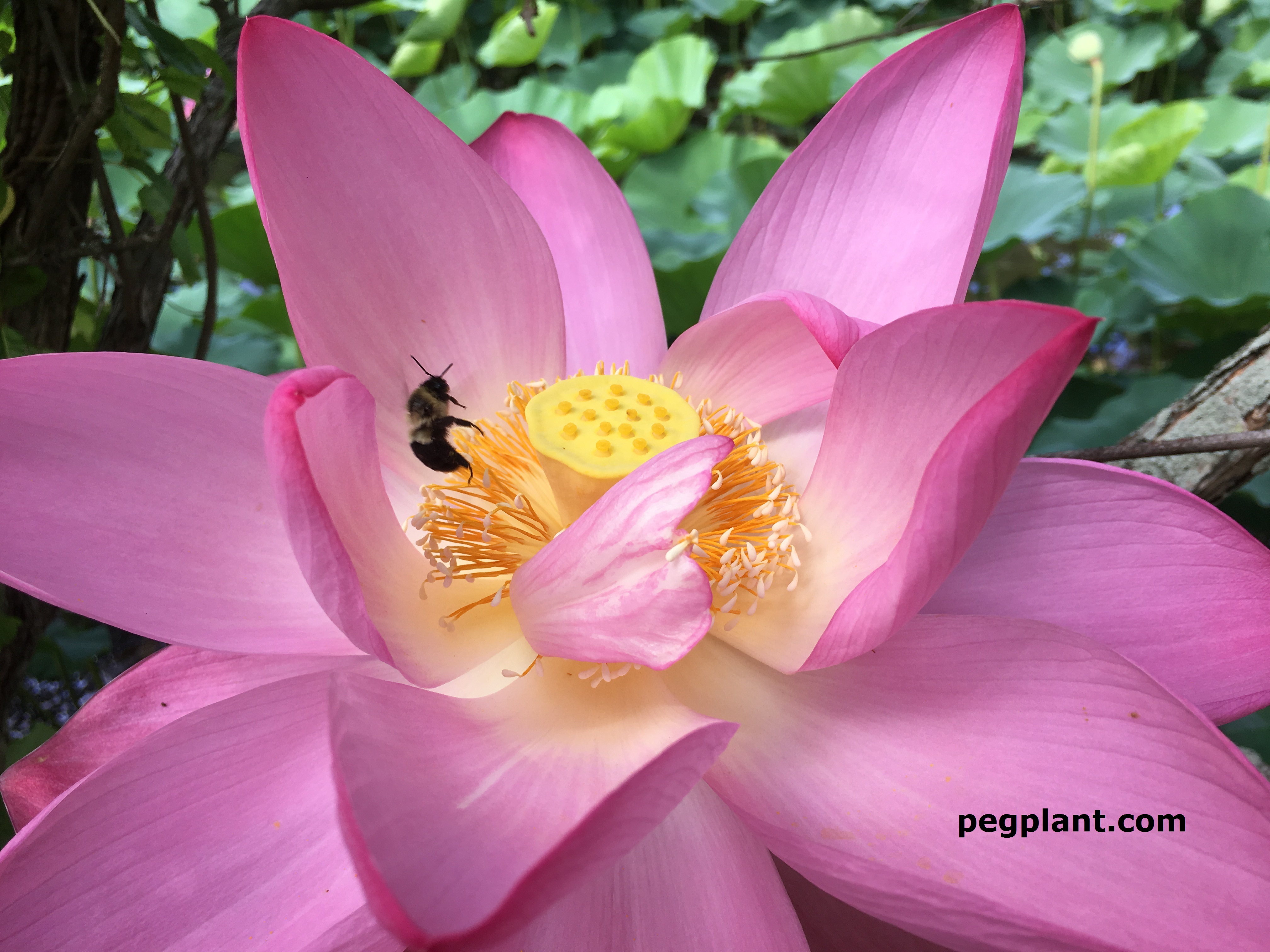
Down the trail was a field of the sacred Asian lotus, Nelumbo nucifera. There were thousands of blossoms and seed heads with leaves larger than dinner plates. Beyond that were more ponds with water lilies and more lotus. There were many other water loving plants on the paths including buttonbush (Cephalanthus occidentalis), swamp mallow (Hibiscus moscheutos),  and bald cypress (Taxodium distichum). Frogs, turtles, butterflies, dragonflies, and plenty of birds were in view and I heard there were beavers, ducks, and herons.

Further out was a boardwalk to the Kenilworth Marsh, the last surviving tidal marsh on the Anacostia River. This wild, natural area gives a glimpse of what the river would have looked like 300 years ago when it was inhabited by Nacotchtank American Indians (Jesuit priests later changed the name to Anacostia).

The Kenilworth Park and Aquatic Gardens, located within the Anacostia Park, is the only National Park Service unit dedicated to cultivating water loving plants.  It is comprised of more than 45 ponds filled with a variety of tropical and hardy water lilies, lotus, and other aquatic species. This land was originally owned by Walter B. Shaw, a veteran of the Civil War. He had a clerical position with the U.S. Treasury Department and purchased 30 acres in the 1880’s. He planted water lilies from his hometown in Maine in a pond that was used to make ice. As he built more ponds and grew more water lilies, he developed the W.B. Shaw Lily Ponds business. His daughter, Helen, managed the business and traveled the world looking for more varieties of water lilies and lotus. When the U.S. Army Corps of Engineers was ordered to dredge the Anacostia River, threatening to destroy the gardens, Congress purchased 8 acres in 1938 to preserve the area and the plants. The National Park Service received the property and renamed the gardens Kenilworth.

Even though the annual festival is over, the water lilies and lotus are still there in full bloom. Visit in the morning as many flowers will close up in the afternoon or when temperatures are above 90 degrees. The hardy water lilies begin blooming in early May and tropical water lilies bloom from early June through early fall. The lotus bloom from late June through the end of August. I overheard a ranger say that they have the giant Amazonian water lily (Victoria trickeri) but the leaves do not reach mature size until September. If you are interested in volunteering  or learning more about their other events, contact the Friends of Kenilworth Aquatic Gardens.

Petite Jenny’s Lavender-Rose Flowers Sway Like a Calder Mobile

Last year I received a small green plant that just sat in my garden all year long. It really did not grow much, it did not bloom, it just took up 6 inches of space. I assumed it was on its way to the pearly gates. This year, it has bloomed so well I would not mind having a few more! Lychnis ‘Petite Jenny’ has leaves at the base (a basal rosette) with inch-wide lavender-rose, tufted blossoms atop 12-inch wiry stems. Petite Jenny started blooming in April in my Virginia garden and should bloom all summer long. Because the flowers sit atop the thin stems, the blossoms sway in the breeze, much like a Calder mobile.

Now that it is flowering (its alive!), I realized I was fortunate to plant mine next to a ninebark called ‘Summer Wine’ (Physocarpus opulifolius). Summer Wine is a small bush with dark, red/purple foliage that complements Petite Jenny’s lavender-rose flowers and also provides a dark backdrop to make it easier to see the flowers.

Hardy to zone 5, Petite Jenny prefers full sun to part shade and more moist than dry soil. It is deer resistant and the flowers can be cut for arrangements. There is a “Jenny” that is a larger plant; Petite Jenny is a dwarf form with sterile blossoms (sterile blossoms have a longer blooming period). Petite Jenny is a Blooms of Bressingham introduction. If this great perennial is not available at your local independent garden center, contact http://www.musthaveperennials.com

Thirty Tours Across the Commonwealth During Virginia’s Historic Garden Week

fountain turned planter

Sponsored by the Garden Club of Virginia (GCV), Historic Garden Week (HGW) is an opportunity for the public to tour almost 250 private homes and gardens and historical sites in Virginia. A non-profit organization, the GCV is comprised of 47 member clubs and 3,400 volunteers. Proceeds from the annual HGW, which originated in 1927, fund the restoration and preservation of Virginia’s historical gardens and provide graduate level research fellowships for building comprehensive and ongoing records of historic gardens and landscapes in the Commonwealth. For more than 80 years, the grounds of Virginia’s most cherished historic landmarks including Mount Vernon, Monticello, and the Executive Mansion in Richmond have been restored or preserved using proceeds from this statewide house and garden tour.

Japanese maple among tulips

This year there will be 30 tours hosted by volunteers at local GCV member clubs. The GCV has member clubs in 6 regions: Northern Virginia, Chesapeake Bay, Coastal Virginia, Capitol Region, Shenandoah Valley/Central Virginia, and Southern Virginia. For example, in the Northern Virginia Region, there will be tours in Old Town Alexandria, Leesburg and Oatlands, Reston, Warrenton, Little Washington, and Winchester on various days between April 22 and 29. In 2015, I visited homes and gardens in Clifton and Fairfax Station one day and Warrenton another day (the photos were taken on my trips).

inner circle of kitchen garden

The schedule is available online and tickets can be purchased on the day of the tour at numerous locations or in advance. Tours are held rain or shine. Properties can be visited in any order. Also available is the Guidebook, a 240-page, beautifully illustrated publication, which can be downloaded, purchased online, or picked up free at designated public places. I always find them in March at my local library. The Guidebook has descriptions of the tour sites, directions, refreshments, special activities in the area, and other places of interest which usually include historical sites that can be toured at other times of the year (for future reference). The Guidebook is a snapshot of the touring area; it lists names of the sponsoring Garden Club member organizations; area information such as Chamber of Commerce & historical societies; and advertisements from local businesses such as garden centers, antique stores, and restaurants. For more information, visit http://www.vagardenweek.org; e-mail historicgardenweek@gmail.com; (804) 644-7776.

Garden Bloggers Bloom Day: Shamrock Plants

Although it looks like a three-leaf clover because of its trifoliate leaf structure, a shamrock plant is actually a species of Oxalis. These green or burgundy foliage plants are often sold as novelty houseplants, especially around St. Patrick’s Day. The small flowers rise high above the leaves with five white or pink to white petals. Most people grow them as houseplants but they can be grown outdoors in the summer here in Virginia. Because they are small, it is best to grow them in containers (off the ground level) for better viewing. Shamrock plants grow from rhizomes called pips which can rot if overwatered so it is best to let the soil dry out a little between watering. Eventually the plant will go through a dormant period and produce more pips that can be dug up for more plants.

The plant is best grown in indirect light with cool temperatures. Usually it is only after you purchase the plant that you learn of its charm:  the leaves move up and down every day. In the daytime, at maximum light, the leaves are horizontal or open. By nightfall, when light levels are reduced, the leaves bend down almost as if the plant is wilting. Don’t worry, this is normal and does not mean that you have to water.

Shamrocks are beautiful houseplants but there is one caveat: they do not combine well with pets. Oxalis contains a high level of oxalic acid, which can be poisonous.

Beware the Bradford Pear Tree!

Spring is in the air and so is the white flowering Bradford pear (Pyrus calleryana). You have probably seen tons of them in the Washington DC metro area. Right now in March, they are really pretty with so many small white flowers – like giant puffs of white clouds. But then you begin to see them everywhere: along the highway, in vacated lots, and in every industrial park – like weeds. The Bradford pear was originally thought to be a sterile tree. As new cultivars were created, the cultivars were able to cross pollinate, resulting in small “pears” favored by birds (thus spreading the seed). As time has gone by and the trees have matured, we have learned that they are structurally weak. They develop such a steep V-shaped branching structure, they can easily split in half. Recently, I learned another reason to not plant these weeds.

Last week, when I picked up the kids from school, they complaining of a foul, fish-like odor. I said it was probably the fresh mulch the landscapers applied on the school grounds but they said no, it was the white-flowering trees at their school. I pulled down a branch and sniffed. Sure enough, it smelled like fish! I never knew that about Bradford pears – just another reason not to plant them.

Spring Is Near: Is It Wise to Buy the Plants at the Garden Centers?

Pansy

Pansy

I was at a local Virginia garden center this weekend and saw four plants that are popular to buy now in the early spring. They had such small tags, you would not know the full scoop if you had bought them.

Pansies: They are beautiful and out of these four plants, pansies would have the most colorful impact now. They come in a range of colors and can be used in hanging baskets, containers, and in the ground. But, they prefer cool weather and will not last through our hot and humid summers. By the beginning of summer, you will pull them out if the deer and rabbits do not get to them first. These are annuals meaning they only survive for one growing season. In our area, they really are only useful in the spring when they bloom. They do not make good cut flowers.


Alyssum

Alyssum

Alyssum: Usually one only finds white flowered alyssum which is not my favorite color in the garden. They are not cut flowers but their form lends themselves to hanging baskets, containers, and in the ground, along the walkway. Alyssum likes cool weather but will do well in the summer. Their tiny flowers attract the pollinators including bees and beneficial insects but not deer. These annuals will die with frost in the fall but you will have gotten your money’s worth.


Dianthus

Dianthus

Dianthus: Related to carnations, this type of dianthus likes full sun and can be drought tolerant once established. The flowers are small, but could be cut for a small vase. The plant adds color, usually the flowers are pink to red, but the plant lies low to the ground. Its form does not lend itself for hanging baskets; they are best used on terraces, rock gardens, garden beds. The plant might come back the next year but they do not have a long life and are treated as annuals here.


Snapdragons

Snapdragons

Snapdragons: The flowers are beautiful, come in a range of colors, and can be cut for vases. They bloom in the cool spring months, the plant simply grows and persists during the summer, and they may bloom again in the cool autumn. Mine have come back the following year but not years after that.  Usually they are grown in the ground,  or containers, not hanging baskets. Snapdragons are deer resistant.

New Videos on Plant Propagation From Virginia Cooperative Extension Master Gardener Program

The Virginia Cooperative Extension Master Gardener Program has produced a series of 10 short videos on YouTube about plant propagation. Filmed in the Virginia Tech greenhouses, each video is about 4 minutes or less. Topics include seeding, transplanting, grafting, air layering, tomato grafting, and the many different types of plant division. These will be helpful as you begin to start seeds indoors now or if you are interested in dividing and multiplying your houseplants.