Category Archives: flowers

Cool Season, Hardy Annuals for Spring Flowers

snapdragons

Now is the time to plant cool season, hardy annuals. Annual plants grow and die in one season. Usually we think of the warm season annuals (i.e., summer) such as marigolds and petunias. However, cool season, hardy annuals are started in the fall, don’t mind the winter, and bloom during the cool spring months before summer.  Typically these are started from seed now and planted in the fall before our first frost in late October. Continue reading

Evening Bloomers: Four O’ Clocks

yellow four o’ clocks in my garden, 8:30 pm

A few years ago my family visited Monticello in the summer. I was struck by how large Thomas Jefferson’s four o’ clocks (Mirabilis jalapa) were compared to mine. I also liked the fact that it was a plant he grew and could still be grown today. Four o’ clocks are heirloom, perennial plants that bloom in the summer. Continue reading

A DC Gem: Lotus Flowers and Water Lilies at Kenilworth Park and Aquatic Gardens

Before the pandemic, I visited the annual water lily and lotus festival at Kenilworth Park and Aquatic Gardens. The free, family event was all day long in July.  I arrived early to park nearby but there was a shuttle that ferried people from the metro station and other parking lots. The music had already started. There was a stage with a band, plenty of picnic tables, and paper lotus-shaped lanterns strung from trees. People from several local organizations were setting up tables to either inform the public of their organization, offer crafts for kids, sell or make the paper lanterns, try lotus tea, and other activities. Many families brought coolers to eat lunch. Later I spied several food trucks parked on the street. There was a small gift shop, plenty of bathrooms, and very informative rangers. There also were volunteer from the Friends of Kenilworth Aquatic Gardens distributing brochures. Continue reading

Flowers for the Evening: Four O’ Clocks

yellow four o’ clocks in my garden, 8:30 pm

A few years ago my family visited Monticello in the summer. I was struck by how large Thomas Jefferson’s four o’ clocks (Mirabilis jalapa) were compared to mine. I also liked the fact that it was a plant he grew and wrote about in his journal. These heirloom flowers are still grown today.

Although I had a few small plants in dry, lean soil in full sun, I was inspired to start new plants from seed. I planted them in very rich soil, in an area of the garden that received morning sun and afternoon shade. They thrived and grew to be about 2 feet tall with light green leaves and many yellow or pink blossoms.

Although they are named for opening at 4:00 pm, mine never do. The blossoms are sensitive to light and temperature and prefer to open when the evening cools down, closer to 7:00 pm in my garden. They stay open all night long. In the fall, they develop large black seeds that are very easy to pick and save.

flower begins to open in evening

Flower colors come in pink, white, red, yellow, magenta, or mixed, liked speckled. They are tender perennials which means they will grow as perennials in the south. In my zone 7 garden, they should grow as annuals but mine must be in a special micro-climate because mine come back every year.  For people who are north of me, they can try to dig and save the tubers for next year, or start new seed next year. I have a friend who says they are considered aggressive in southern Virginia but I have not had any issues with mine. I heard a horticulturist at a public garden in Atlanta, GA, say that they grow them for the evening visitors, who come to walk the gardens when the temperatures have cooled down.

Four o’ clocks were cultivated and selected for various colors by the Aztecs prior to the Spanish Conquest. They were then introduced to Spain and England and were in cultivation in Europe for about 200 years before Linnaeus first described the species in 1753. Thomas Jefferson received his from France. In July 1767, he noted in his journal “Mirabilis just opened, very clever.”

Try these heirloom plants for an evening garden. The seed are very easy to save so you may see some at seed swaps but if not, try these seed companies.

pink four o’ clocks at Monticello, early afternoon

May Is Dahlia Planting Time

Mother’s Day signals the time to plant dahlias. Like chrysanthemums, many people associate dahlias with the fall but dahlias can bloom from the beginning of summer to frost. Dahlia flowers are available in a wide range of sizes, colors, and shapes. Each bloom can be 2 inches across to more than 10 inches, in all colors except blue. Plants can reach one to 6 feet tall. Some plants have beautiful dark foliage instead of green leaves. Although there are 40 plus species there are thousands of cultivars. In addition, there are numerous forms such as the single, peony, anemone, collerette, star or single orchid, double orchid, cactus, waterlily, ball, and pompom. Continue reading

A Great Houseplant for the Winter: Anthurium

When I was young, we lived in Thailand and my mother (who grew up in Milwaukee) would buy plants and orchids from the market. I remember one houseplant in particular. The beautiful flowers were so waxy they looked like they had been polished with furniture polish. The red flowers would last for months. We did not know the names of the plants but we enjoyed their exotic beauty. Now that I am older, I know the waxy plants are called anthuriums. Although I associate them with tropical Asian countries, they really hail from South America tropical environments.

Anthuriums are members of the Araceae or arum family. The “flower,” the red, heart-shaped part, is a modified leaf called a spathe. The actual flowers are tiny and appear in the center vertical structure called the spadix. The “flower” lasts a long time, making them ideal for cut flower arrangements.

As a houseplant, anthuriums can grow in low light conditions. However, the more light you can provide the more likely it will bloom throughout the year. It definitely does not like moist soil. Water when the soil is dry to the touch. Anthuriums are easy, low maintenance plants, perfect for the home and office.

Usually one sees red-flowering plants at the hardware store or nursery but pink, green and white, and purple colored cultivars are available. There is even a black flower cultivar called ‘Black Love‘. My plant was less than ten dollars at the local hardware store but it was very root bound in a 4-inch pot so check your plant’s roots after you purchase it.

Anthuriums are the perfect winter houseplant: the flowers last a long time and the plant has an exotic, year round appeal. Try growing this easy houseplant or purchase one as a hostess gift when you visit family and friends this year.

Winter Blooming Witch Hazel

Early Bird

Early Bird

One of my favorite winter bloomers is witch hazel, a small shrub-like tree.  The flowers themselves are only a few inches, but their unique shape and ability to cover dark, bare stems with flashes of color add excitement in winter gardens. The flowers are really clusters of four petals shaped like thin ribbons emanating from a dark, leathery base called a calyx. Depending on the cultivar, these one-inch to two-inch long ribbons are translucent yellow or mustard yellow, red/orange or brown/orange, or scarlet red or rust red. On warm winter days, the ribbons unfurl. As temperatures drop, the ribbons curl back as a protective mechanism against the cold. Continue reading

Fall Bloomers: Mexican Sunflowers

Mexican sunflowerMexican sunflowers (Tithonia rotundifolia) are very tall, fall blooming annuals. Usually the blossoms are about 3 inches wide, daisy-shaped and orange. Bees and butterflies love the flowers, which are also good for cut flower arrangements.

When Mexican sunflower blooms from September to frost, the sun is at an angle and the light is softer, so the orange is quite nice in the garden. It is not a garish color at all and really blends well with the whole pumpkin fall theme.

The nice thing about this plant is that it is easy to grow from seed and it is easy to collect the seed. When the flower head is past its prime and the resulting seed head is mature, the flower head turns brown and bends down so it is obvious when to cut and save the seed. I cut off the seed heads and save them in a paper bag. In the winter, I separate the actual seed, package them, and give to friends.seedhead

These plants are not fussy. They need full sun, tolerate poor but well-drained soil, should not be fertilized, and are deer resistant. They may need to be staked but there are shorter cultivars on the market. Fiesta del Sol, an All-America Selection (AAS) flower winner in 2000, is the first dwarf at 3 feet tall, making it perfect for containers. Goldfinger is 3 feet tall with orange and gold flowers. Torch is a 1951 AAS flower award winner and Yellow Torch has apricot yellow orange flowers. Both of these can grow to 4 to 6 feet tall. All the plants bloom from September until frost here in the DC metro area.

Try growing Mexican sunflowers, you will be pleasantly surprised at the pretty fall flowers and intense pollinator activity.

Mandevilla: Tropical Beauties Worth Keeping

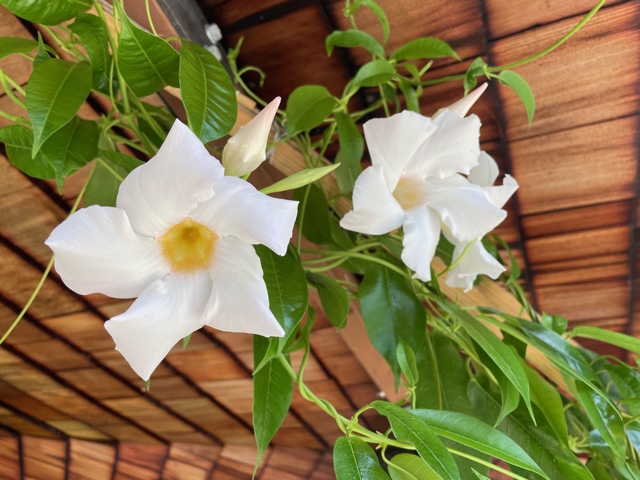
mandevillaRecently I was given a mandevilla plant, which is a popular summer bloomer in the DC metro area.  I have always admired these vigorous climbers with bright, large, trumpet-shaped flowers. Usually, I see pink, red, or white blossoms, but there are other colors on the market. Continue reading

Deer-Resistant, Fall-Blooming Obedient Plant

Obedient Plant

Obedient Plant

A familiar fall bloomer in this area is obedient plant (Physostegia virginiana). These remind me of early American gardens: Thomas Jefferson grew these Native American perennials at Monticello, and George Washington had plantings at Mt. Vernon. Philadelphia plantsman John Bartram also grew them and sold them in his catalog. They are passalong plants, easily divided and shared.  My plants came from a friend who pulled a clump from her garden several years ago. My original plant has thrived and spread via rhizomes (underground stems) but only a few feet in the same garden bed. Not too much but just enough to provide extra plants to share and abundant flowers to cut for an arrangement. Continue reading