
Tag Archives: Mandevilla

Mandevilla or Dipladenia? What’s the Difference?

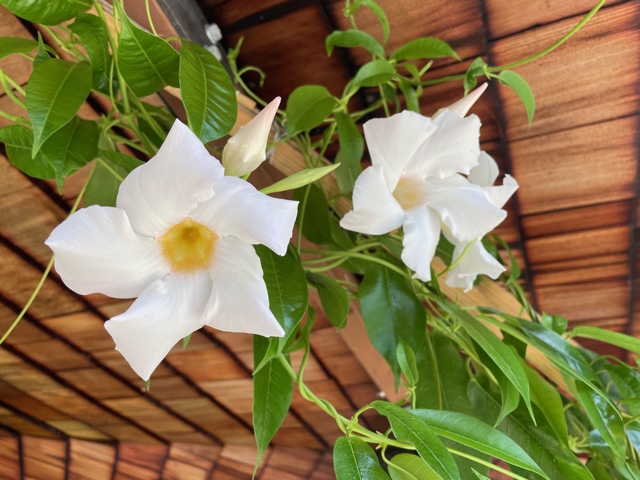
Dipladenia ‘White Halo’ in my garden

In past years, I have grown Mandevilla plants but this year I have a Dipladenia growing in a container. I know the name is a mouthful, they have to come up with an easier name to pronounce, let alone spell. My Dipladenia is a Flordenia type which is supposed to be more floriferous, stronger branching, and heat and drought tolerant. I have White Halo which of course has white flowers.

Both Mandevilla and Dipladenia plants are popular tropical plants. They bloom all summer long in full sun, undaunted by dry spells.  The flowers are very similar, trumpet-shaped, in a range of white, pink, reds, yellow and even peach.

But there is one distinct difference between the two.

Mandevilla with hoya-like foliage

Mandevilla is a vining plant; it climbs up to the sunlight. You purchase it with the intent to cover an arbor, pergola, or obelisk. The stems and foliage remind me of a hoya plant (in fact, they are cousins). The leaves seem larger than the Dipladenia, pointed and glossy. However, if you purchased a Mandevilla and would like to grow it as a shrub, you can just prune it.

A Dipladenia is a shrub, it will not climb up a structure. This makes it perfect for containers and hanging baskets. The foliage is smaller, more compact, and more matte than glossy. The space between nodes (joints where leaves arise) is shorter than the Mandevilla. It is more of a slow grower while a Mandevilla will grow fast to cover a structure. Although they both have trumpet-shaped flowers, to me the Dipladenia flowers appear flatter with a shallow throat.

Dipladenia with compact foliage

Both are full sun, drought tolerant with no need to deadhead (the older I get the more important this is to me). They attract pollinators and are deer and rabbit resistant.

As fall approaches, they can be kept overwinter in order to plant in the garden the following year (these are not cheap plants). There are several ways to do this depending on the space and light in your house. You can root 4 to 6-inch stem cuttings and grow them inside as houseplants. You can give your plant a good trim in the fall, up to one half of the foliage to reduce transpiration, bring the plant in and place in a sunny, cool location and water less often. Or you can cut the foliage back severely, place the plant in a cool, dark place and stop watering. Let it go dormant for the winter but check on it so it does not dry out completely.

Don’t be surprised if containers of Mandevilla and Dipladenia get mixed up at the local garden centers. Most people do not recognize the difference. Regardless, they are great investments for constant summer blooms especially when we have dry summers such as this one.

Mandevilla
Mandevilla: Tropical Beauties Worth Keeping

mandevillaMandevilla plants are popular summer bloomers here in this area.  I have always admired these vigorous climbers with bright, large, trumpet-shaped flowers. Usually, I see pink, red, or white blossoms, but there are other colors on the market.

Mandevilla is a member of the Apocynaceae family, also known as the dogbane family, cousin to Plumeria (frangipani), Nerium (oleander), Vinca (periwinkle), Amsonia (blue star), and Hoya (wax plant). Native to southeastern United States, Mexico, Central America, South America, and the West Indies, these are considered tropical plants here in the DC area. Mandevilla was named after Henry Mandeville, a British diplomat and gardener who discovered this plant in Argentina and sent it back to England in the 1800s.

tango twirl mandevilla

Tango Twirl has fully double petals, photo courtesy of Doreen Wynja for Monrovia

In recent years, there has been a tremendous amount of hybridizing with mandevillas. There are many lines or series such as Sun Parasol, Sunvilla, Bombshell, and Parfait. There are plants that are more compact than the species, really compact for containers, and plants with variegated foliage, double-petaled flowers, and new flower colors such as apricot. They are all beautiful, but they are not cheap. Although they may cost a little more, they thrive in our hot, humid summers; are deer and rabbit resistant; and attract butterflies and hummingbirds.

They do need support and should be planted with a trellis or obelisk or planted near a pergola or a fence. If they are grown in containers, they will need fertilizer in the summer for continuous blooms.  They are actually very versatile. I have seen them in containers at gas stations where they thrive despite the heat and neglect and I have seen them used to decorate arbors, arbors and pergolas.

arch

Brookside Gardens in Wheaton, Maryland

Because these are tropical vines, hardy to Zone 10, they will die here in the DC area in the winter. But you can protect them over the winter so they can be brought outside again next year for another season of beauty.

apricot colored flower

Apricot is an unusual, apricot colored flower, photo courtesy of Doreen Wynja for Monrovia

There are basically two ways to do this. One is to grow them like houseplants indoors and the other is to let them go dormant for the winter. In the fall, before the temperatures dip below fifty degrees, bring the plant inside. Remember that night temperatures can dip below fifty even though day temperatures are still warm in the fall.

To grow like a houseplant, trim them back first. It can be a real haircut, up to one half of the foliage, but do it so you are removing leaves and stems for reducing transpiration, not to make it ugly. Then place in a room that has much light as possible while as cool as possible. Water less frequently; do not fertilize. It may not bloom but that is okay, it is just surviving for a few months. Keep watching for pests. In the spring, prune and fertilize. In early June bring the plant outside. Place in shade first and gradually move to full sun.

The dormant method is to bring the plant indoors and trim back to about twelve inches. Put in a cool garage or basement where temperature is above freezing. Make sure it does not dry out completely. Water only to prevent it from drying out. In the spring, bring it in the house to increased light and heat. In early June, bring it outside. Again, shade first and gradually to full sun.

This way, your mandevilla plant should provide color every summer and you will certainly get your money’s worth.


Mandevilla: Tropical Beauties Worth Keeping

mandevillaRecently I was given a mandevilla plant, which is a popular summer bloomer in the DC metro area.  I have always admired these vigorous climbers with bright, large, trumpet-shaped flowers. Usually, I see pink, red, or white blossoms, but there are other colors on the market. Continue reading